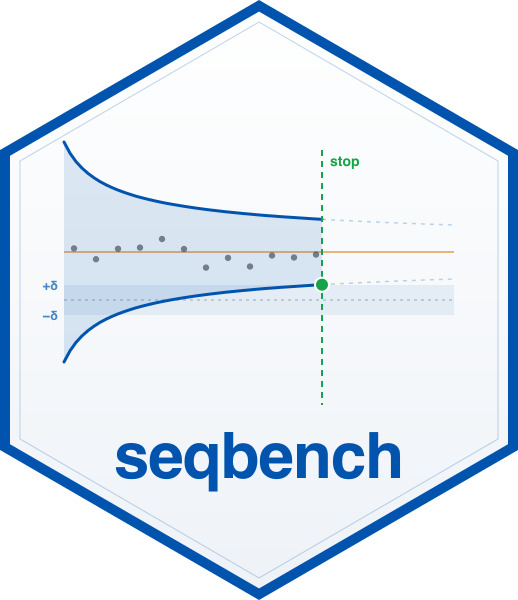


Anytime-valid sequential benchmarking of algorithms.
seqbench answers one question: when can I stop
comparing algorithm A with algorithm B without invalidating the
inference? It treats a benchmark as a sequential experiment on
paired losses (same instance, same seed) and maintains
a confidence sequence for the mean paired difference that stays valid
under optional stopping, repeated inspection and adaptive budgets.
Three declarations are possible, all relative to a pre-registered
margin of practical relevance δ:
| Declaration | Condition on the current confidence sequence C_t |
|---|---|
| A is relevantly better | upper limit of C_t below −δ |
| B is relevantly better | lower limit of C_t above +δ |
| Practically equivalent | C_t inside [−δ, +δ] |
| Continue | none of the above and budget remains |
| Inconclusive | none of the above and the budget is exhausted (or C_t
is empty) |
Version 0.1.0, first release; the API is experimental and may change
in minor releases. Implemented: five boundaries (betting, empirical
Bernstein, Hoeffding, Bernstein with a declared variance bound, and an
invalid fixed-sample negative control), instance-level updating with
seeds as clusters, the three-way decision rule, budget accounting, and
print, summary, tidy,
glance and autoplot methods.
library(seqbench)

design <- comparison_design(alpha = 0.05, margin = 0.02, bounds = c(0, 1),
                            boundary = "betting", budget = 500)
state  <- initialize_comparison(design)

# paired losses: one row per (instance, seed); losses within `bounds`
losses <- data.frame(instance = 1:40, seed = 1,
                     loss_a = runif(40, 0.1, 0.4), loss_b = runif(40, 0.3, 0.6))
state  <- update_comparison(state, losses)

stopping_decision(state)     # "A", "B", "equivalent", "continue" or "inconclusive"
comparison_report(state)     # estimand, estimate, C_t, assumptions, cost, seeds, versions
tidy(state)                  # trajectory, one row per instance
ggplot2::autoplot(state)     # C_t against t with the [-margin, margin] band
Instances are the sequential unit; several seeds of the same instance
are averaged into one observation. Losses outside bounds,
missing values and instances that reappear after their losses were seen
are errors, never silently converted.
install.packages("seqbench")            # CRAN, once released

# development version
# install.packages("pak")
pak::pak("castlaboratory/seqbench")seqbench is not a general confidence-sequence library.
For that see confseq (Python), safestats and avlm (R). The CRAN
package seqcomp
compares probabilistic forecasts sequentially;
seqbench compares algorithms on paired losses with
an equivalence margin and explicit cost accounting.
GPL (>= 3). © CAST Lab, Universidade Federal de Pernambuco.